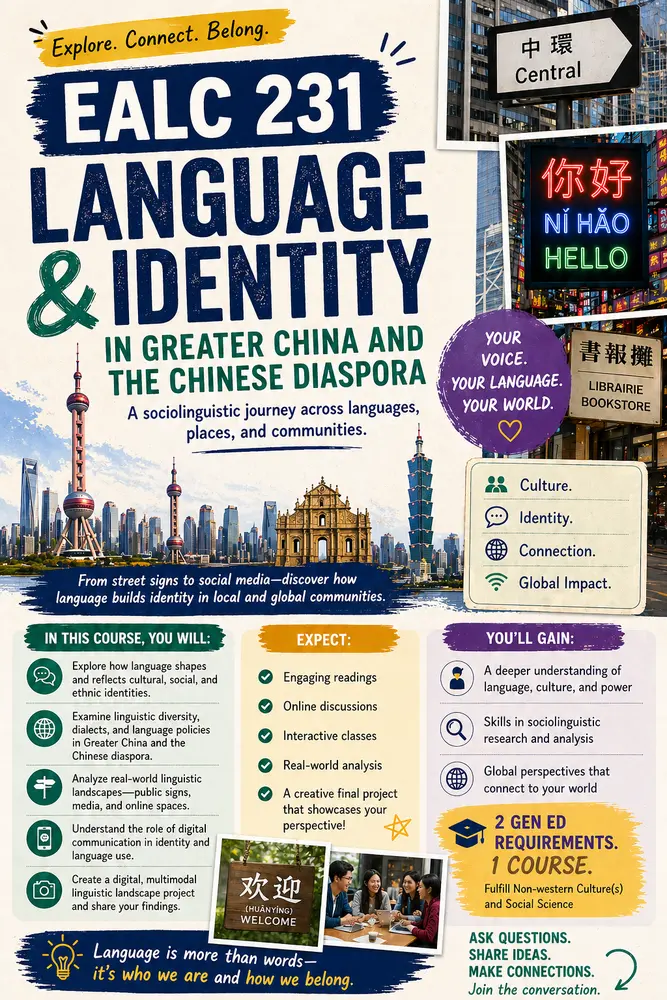
Course Description
This course explores the intricate relationship between language and identity in both Greater China (Mainland China, Hong Kong, Macau, and Taiwan) and Chinese diasporic communities around the world. Through the lens of sociolinguistics, students will examine how language is used to construct and negotiate social, cultural, and ethnic identities, as well as how it reflects power dynamics and globalization trends. Topics covered include the linguistic diversity of Greater China, heritage language maintenance, bilingualism, language policies, and the impact of digital communication on language and identity.
Students will analyze real-world linguistic landscapes—such as public signage, media, and online spaces—both in China and diasporic contexts to understand how language contributes to identity formation. Additionally, the course will address issues of language shift, intergenerational language transmission, and the sociopolitical implications of language use in multicultural environments. Course activities include readings, online discussion posts, in-class discussions, and a final project in which you will document and interpret a linguistic landscape. By the end of the course, students will have developed a deeper understanding of how language both shapes and reflects identity, culture, and social belonging across the Chinese-speaking world. This course is designed for students interested in sociolinguistics, Chinese studies, cultural studies, and identity politics in contemporary global contexts.
Learning Outcomes
In this course, students will:
- explain how language shapes and reflects cultural, social, and ethnic identities in both Greater China and diasporic communities;
- critically evaluate the linguistic diversity within Greater China (e.g., regional dialects, language policies) and compare it to language use and identity formation in the Chinese diaspora;
- analyze and interpret public signage and multilingual environments in both Greater China and diasporic communities, understanding their implications for identity, power, and cultural negotiation;
- explain the role of digital communication in shaping linguistic practices and identity among Chinese speakers in both regional and global contexts;
- design and conduct a digital multimodal linguistic landscape project that applies sociolinguistic research methods to real-world contexts.
General Education Categories
- Non-western Culture(s)
- Social Science
Prerequisites
None: there are no prerequisites for EALC 231.