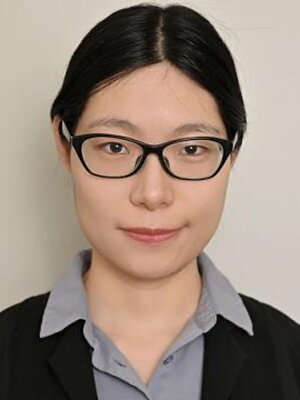
The Department of East Asian Languages and Cultures is delighted to welcome Dr. Yunxin Li to the faculty. Trained across history, literature, and digital humanities, Dr. Li brings an exciting interdisciplinary perspective to the study of early China that speaks to questions of power, gender, social relations, and knowledge across time. Her scholarship and teaching exemplify a thoughtful integration of rigorous humanistic inquiry with innovative digital methods, and her work resonates strongly with EALC’s commitment to collaborative, cross-field engagement. We are excited to have Dr. Li join our intellectual community and look forward to the contributions she will make to research, teaching, and graduate mentorship at UIUC.
Dr. Yunxin Li received her B.A. and M.A. from Peking University and her Ph.D. in Chinese history from Stanford University in 2022. She taught at Simmons University, Boston, before joining UIUC. Her work is informed by her interdisciplinary training in Chinese philology, classical Chinese literature, history, and digital humanities. Her research focuses on the political, social, and gender histories of early China. She is also interested in comparative empire studies, legal history, Chinese medicine, material culture, manuscript studies, and intellectual history.
Dr. Li’s work has appeared in journals such as Bulletin of the Jao Tsung-I Academy of Sinology, Asian Journal of Law and Society, and Journal of Chinese History. Her book manuscript in progress explores the entanglement between imperial power and personal relations– gender, family, and social networks– at the Han inner court. Her research has received support from Stanford Center for East Asian Studies, the Mellon Foundation, Mabelle McLeod Lewis Memorial Fund, and Simmons Center for Information Literacy.
As a digital historian, Dr. Li has curated the Han Elites’ Social Network Dataset and Han Nobles (Lie Hou) Dataset, both of which are publicly available. She is committed to teaching students digital literacy in the classroom through the integration of various software applications, data analysis, and visualization into the curriculum. She believes that it is important for humanities scholars and students to learn new technology and explore new methods on the one hand, and on the other hand, to remain critical of technocentrism and to uphold the liberal arts.
Dr. Li has taught courses on world history, premodern and modern Asia, early and medieval China, gender and sexuality in Chinese history, digital humanities, historical methods, and MA thesis. She aims to balance the teaching of skills and content in her class, providing scaffolding and specific guidance while supporting students’ interests and autonomy. At UIUC, she is excited to offer various courses on premodern China and digital humanities. She has mentored a wide range of master’s theses and enjoys working with graduate students on research.
Dr. Li actively serves her field as the Associate Editor of Cambridge University Press’s Elements in Ancient East Asia Series and a member of the Council of Conferences of the Association for Asian Studies. She has been interviewed by Simmons University Communications regarding the North Star Faculty Fellowship and Gender in Early Chinese Medicine, as well as the BBC’s program The Conversation on women’s hidden role in the history of healing.